
 en
en ro
ro
How It All Started
You know when you have your best ideas? When your mind is rested and the voices in your head suddenly start to make sense in what they’re whispering to you.
That’s pretty much what happened at the beginning of 2021, when after a few snowy days I was trying to figure out what new things I could bring to the moto world in Romania and how I could help the MotorBike Community through what I do.
It didn’t take long for me to realize that I was getting more and more questions about motorcycle gear and to notice a growing interest year after year. Which can only make me happy, because that means people understand the importance of proper gear. They want to be protected, they want to go out for rides, and they want to come back safely.
And that’s when the idea hit me! If I’m already doing reviews for motorcycles, why not do them for motorcycle gear as well? People have always been excited about the presentations and have always appreciated the honesty and objectivity with which the information was shared. Okay, but how do I do this? Where do I film? What do I need for filming? What exactly do I film? Who does the research? Who writes the scripts? Who edits? And most importantly: where do I post all this? The idea seemed pretty good, but there were quite a few unknowns, so I took it step by step, like putting together a puzzle. How do I do that? Good question, let’s leave that for later. First, let’s see if I can actually do it.
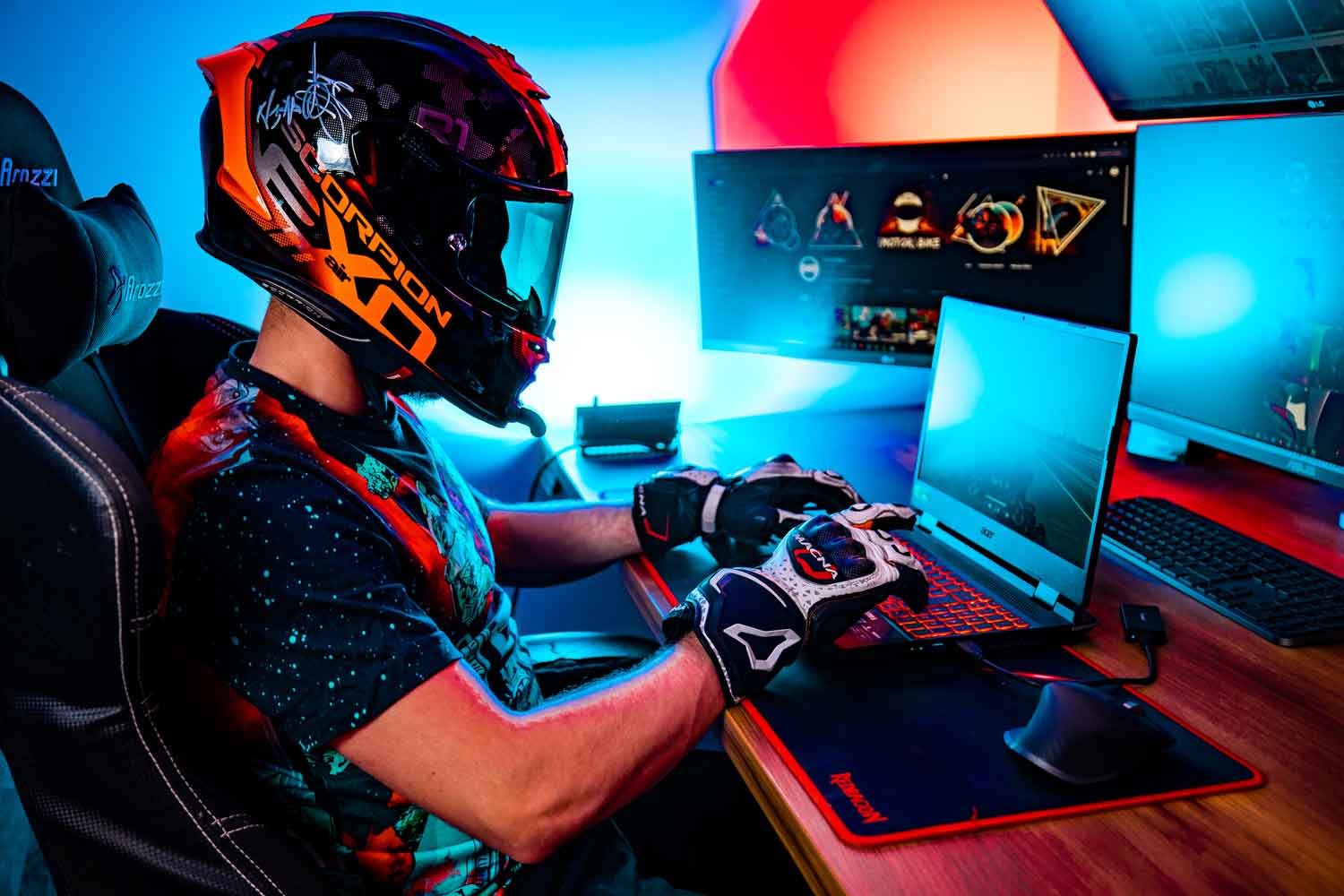
Where do I film? Clearly, I needed a space with controlled lighting, big enough, quiet enough, where I could move around freely. In other words, a studio. That’s what Radu was thinking back in 2021, while renting an apartment with a roommate. I was paying rent just to have a roof over my head, and I was thinking about a studio. Ha, what a joke… And it was still a long way until April 1st. So, let’s see how we can rearrange the small room in the apartment and see what happens. I didn’t call it the small room for nothing, it really was tiny. If I brought in the lights needed for filming, there was no space left for anything else. Not to mention the background a white wall that reflects way too much light. The DSLR was mounted upside down, with a ball head literally glued to the furniture, and I was just hoping it wouldn’t fall off. A few days later, I realized it was a dead end and I had to find another solution. And that solution turned out to be easier to spot than I thought: the living room which was basically my room. Now, besides being a bedroom, a work desk, an editing station, and a setup for YouTube live streams, it was also becoming a filming studio. At least I found a location, now let’s see what needs to be done next.
Okay, but how?
What do I need for filming? A subject which I quickly found in the mirror, gear to present which I found in the next room, and equipment that would allow me to produce good-quality videos. Rather than doing something poorly, I’d rather not do it at all. I already had studio lights, a DSLR with a decent lens, a tripod to hold the camera, and that was about it for the moment. Four days of research later, I realized I needed more:
– Better video quality – the videos need to be 4K, I was no longer satisfied with just Full HD, so I needed a new camera and a new lens – 5200 lei
– Better audio quality – a unidirectional microphone was necessary – 750 lei
– Colored gels for lights – 2 sets – 500 lei
– Tripod + ball head + mobile mount for the second camera – 500 lei
– LED strip to highlight background elements – 500 lei
– Slider for dynamic shots – 750 lei
Whoops… The costs were starting to add up, and I wasn’t sure I was ready for that. And all this on top of the photo, video, and audio gear I already had. It seemed easier at first. And if I calculate all the other equipment needed for production, the total goes over 20,000 lei. What do I film? Well, what do you mean “what”? The gear I already have and have tested in so many situations. And after that? After… Well, we’ll get there eventually. Who does the research? The same guy in the mirror. Nice guy, hard-working, and he’s already handling everything else anyway. Even though it’s a very important task, since the information presented must be accurate, up to date, and reliable any mistake is harshly punished. Especially in terms of salary. Just kidding, he doesn’t get one anyway. Who writes the scripts? Who’s the director? What shots do we film? How do we position the cameras? Who checks the focus? Who sets up the lights? Who checks the audio? What photos do we take? Come on, Răducu, we’ve got work to do! Who edits? Well, since I know what I need to present, what I’m filming, and how I’m arranging everything, I might as well handle the editing too. It’s not like I have much of a choice. Where do I post all this? Now that’s a problem… If I post on (Motor)Bike, not everyone will be interested in every product, so they won’t watch all the videos. That means the YouTube algorithms will notice this and it could end up doing more harm than good.
But if I start a new channel, who will take care of it? I’d need social pages, community management, constant posting, and a lot of time invested.
Now that I’ve taken you a little through the history of the MotorBike Reviews project, let me also tell you a bit about what happens here. The products you see are presented as objectively as possible, based on the characteristics of each piece of gear. After giving a detailed description of the product and making sure each follower understands what it’s about, I move on to rating it. All gear is rated according to the same criteria, except for helmets, where other aspects are considered. The criteria are as follows:
Jackets, pants, suits, gloves, footwear, protections, and accessories are rated for:
- Protection – The level of protection offered both by the gear itself and any included protective elements
- Material – The quality, durability, and resistance of the materials used
- Ventilation – The ventilation provided, an important aspect for hot days
- Waterproof – The level of water resistance offered
- Appearance – Design, colors, cut, accessories, and variety
- City/Daily – Suitability for daily commuting or occasional rides around town, over relatively short distances
- Sport – Sporty riding on the street or track, including competitive riding
- Touring – Long-distance rides in various weather conditions, focusing on comfort and how tiring it may be to wear
- Price – Evaluated for each piece of gear. Gloves are compared to gloves, boots to boots, and so on. This doesn’t measure “how expensive or cheap” a piece is relative to its value
- Personal rating – A personal conclusion based on the analysis of the product through the lens of experience with the gear tested.
Helmets, on the other hand, are rated for specific characteristics, namely:
- Protection – Safety standards, safety tests, and materials used
- Features – Characteristics and special elements offered, from ventilation, shape, sound insulation, additional safety systems, included accessories, etc.
- Ventilation – Both the number of vents in the front area and the exhaust vents, as well as the cutouts and airflow inside
- Appearance – Helmet shape, color schemes, and variety of paint jobs
- City/Daily – Comfort for daily use or short occasional rides
- Sport – Performance in sporty riding on the street or in track competitions
- Touring – Features necessary for long-distance rides spanning hundreds of kilometers or multiple days
- Off-road –Weight, ventilation, field of vision, specific accessories
- Price –Evaluated relative to the extremes available on the market, from €20 helmets to models exceeding €1,500
- Personal rating –A personal conclusion based on the analysis, specifications, and experience with the helmet.

All these scores lead to a total that places each piece of gear in a specific ranking, designed to help any motorcyclist or future motorcyclist choose the optimal gear for them. Everyone has different needs, and what works for you might not work for me, but that doesn’t mean I’m right and you’re wrong. It’s important to know and be aware that gear saves lives, bones, and prevents fractures, and it can make the difference between a trip to the emergency room and a tragicomic memory. Every piece of gear is good in its own way and can have certain advantages, but it will certainly have disadvantages as well. If a jacket is good for the city, the chances that it’s also good for track riding are quite small. If a helmet is good for off-road, it’s hard to imagine it being suitable for touring as well. So, there is no such thing as “the best gear” or “the best helmet,” but there is the most suitable gear and the most suitable helmet for your needs.
And all the products can also be found and sorted according to the needs you have in the gear rankings.


